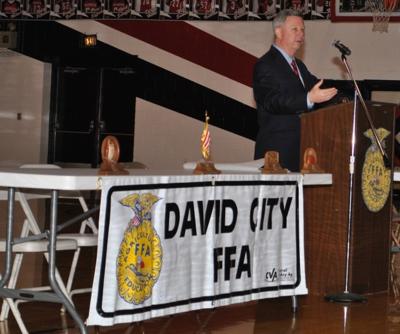



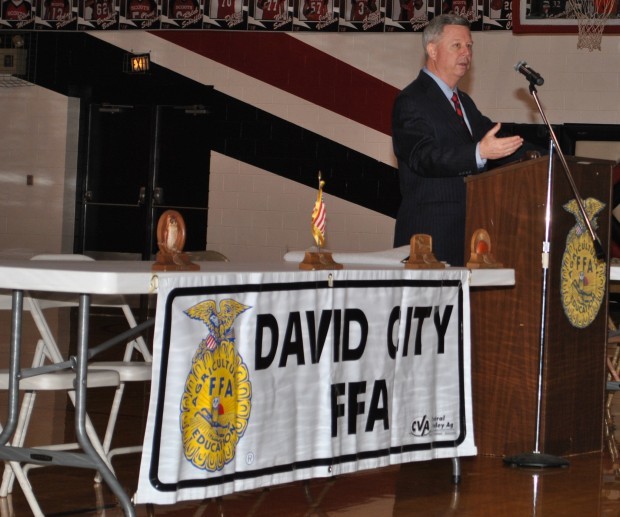
Although the nation's economy has been struggling, Nebraska is faring much better, Gov. Dave Heineman told David City elementary and high school students on Monday.
The main reason for the brighter outlook: agriculture.
The governor made the high school gym one of his four stops on Monday as he traveled from Columbus to Omaha.
He was hosted by the David City High School FFA Chapter, and he was greeted by chapter president Lukas Fricke and chapter parliamentarian Kaleb Scheffler.
Heineman's brief remarks included praise for educators and students in Nebraska - especially in rural areas - and he encouraged students to consider a future in agriculture. It's about more than farming and ranching, the traditional view of agriculture, he said.
People are also reading…
"Alternative energy, biofuels, ethanol, wind energy," he said. "All those things are occurring in rural Nebraska."
Today's young people will continue to have a variety of opportunities as the nation's farmers expand to feed an additional 2 billion people in the world in coming decades - on fewer acres.
He listed the impact of agriculture on Nebraska: $17 billion in revenue in the state last year, growing by 5.5 percent. Exports of $5 billion around the world. Twenty-four ethanol plants producing 2 billion gallons with 35 percent of the state's corn crop. A livestock industry with 6 million cows and calves that is outperforming other states and generating $7 billion for the state's economy.
"You have great opportunities in agriculture and in almost every industry because of technology," he said.
Heineman said that his priorities are a strong education and creating jobs. Those two items require balancing state aid to education with the tax burden and the local control that communities demand.
The governor took questions from students for about 15 minutes, and the queries ranged from his favorite sports teams, his grades (they were As) as a youth in Wahoo.
One student asked what he was doing to protect the state's farms and ranches.
This prompted Heineman's concern about the Humane Society of the United States, which has an ongoing effort to change how animals are raised on farms and large confinements. For example, the HSUS has targeted large operations for how much living space is provided for poultry and dairy cows.
Heineman said the group is about more than animal welfare.
"They are out to destroy the opportunity for all of you to be involved in agriculture. I don't think that is fair," he said. " It's about agriculture and jobs in the future of America. And it's about the future of American agriculture."
Heineman said the HSUS has intimidated leaders, ranchers and farmers in every state where it has had success, but that wouldn't work in Nebraska.
"We're going to stand up and beat 'em. It's like an athletic contest. And then I'm going to go all over America and share with the rest of the United States of America how we did it.
"They are going to come and we are ready to fight."
Regarding the best path to a strong education, Heineman said spending money is not the answer. He noted that the state's schools get 35 percent of their budgets from state aid to schools, and that amount has increased from $635 million to $850 million.
"There's one part of education that doesn't cost a dime. That starts with your parents," he said. "The more the parents are involved, the higher or better the performance of the student."
He said teachers and schools are going to greater lengths, using email or visiting homes, to make sure they talk with parents about their students' progress. He acknowledged that family situations have changed over the years with more working parents, single parent families and grandparents raising their grandchildren.
Heineman also challenged the young people in the stands.
"You can put all the money in the world in education and it doesn't necessarily mean you are going to get better results. Because part of that is up to you, too," he said.
And good grades alone don't add up to success, he said.
"You can be the smartest kid in the class but if you don't apply yourself ... it won't make any difference," he said.