





Looking at NaTerra Farms in David City now versus a year ago, one would hardly recognize the place.
From an old farm house on a largely disheveled property, it has now become a permaculture farm that celebrates the connection between people, plants and animals.
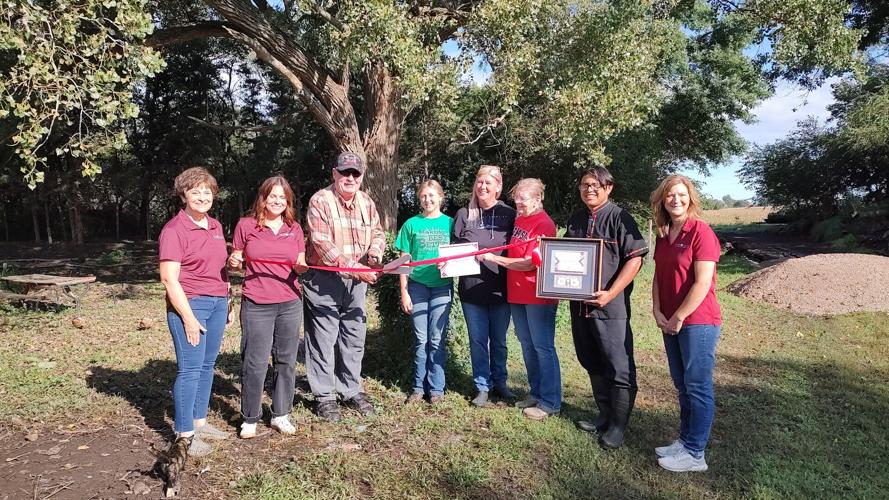
After over a year’s work on the property, Sandro Lopes, land owner Larry Sabata, their families and the Butler County Chamber of Commerce celebrated this transformation and the farm’s addition to the Butler County Chamber with a ribbon cutting on Sept. 20.

Sandro Lopes of NaTerra Farms and Larry and Ann Sabata cut the ribbon on NaTerra Farms in David City with members of the Butler County Chamber of Commerce and the Nebraska Sustainable Agriculture Society on Sept. 20, 2025.
The community came out in full support for Lopes and NaTerra Farms.
On hand included Larry and Ann Sabata, who let Lopes use the land for this project. Lopes met Larry a couple years ago and once they got to talking, he saw Lopes’ vision.
“When I first met them, (Lopes) had a small Amazon garden where he lived in David City,” Larry said. “I’m just glad that I could find him a place to fulfill his dream and hopefully he can continue to keep this going when I’m long gone. So, just keep it up.”
People are also reading…
Also on-hand were the University of Nebraska-Lincoln, its extension office in Butler County, the Nebraska Sustainable Agriculture Society and the Chamber, who were included among the long list of names Lopes thanked for making this work.
The community that helped him to make this happen is exactly who he did it for, he said.
“The community is very important in the process,” he said. “So this is building for the community.”
Cara Morgan, director of the Nebraska Sustainable Agriculture Society, noted just how many people came to this event and were involved in the farm’s story, something she and the group were happy to see.
“I’m very excited to have this be my first tour with the Sustainable Ag Society,” Morgan said. “The short time that I’ve been here, the one thing that I keep hearing, and I just heard it again, was how it’s a community. And you know, seeing this community in here today, thank you, because you brought everybody together, and it’s a wonderful thing to see.”
Lopes took the group on a tour of the farm, including the mandala garden with its circular, almost rippled design. He also showcased the food forest, where Lopes explained the interplay of nature and the animals and how the area is designed to hold water in a certain way rather than flooding.
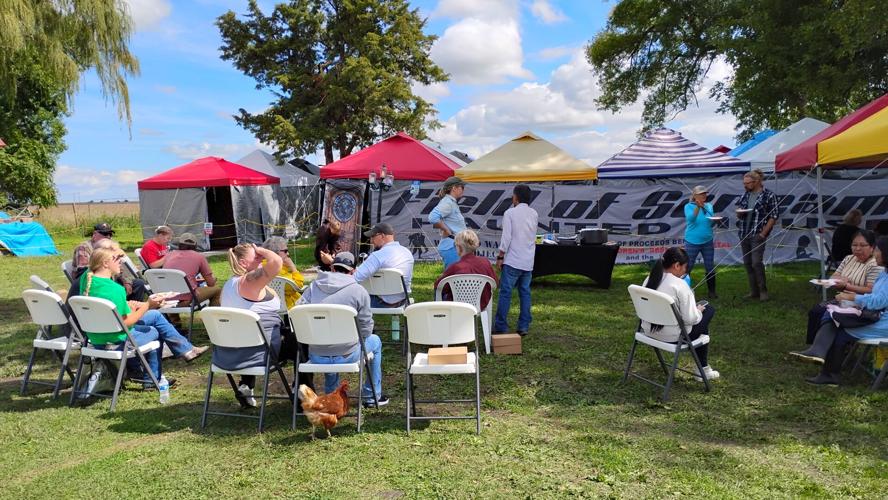
Caro Cordova from the University of Nebraska-Lincoln spoke to the group about soil density and organic carbon content, with a short demonstration of how to test for it.
“The connections we have with UNL are very important, because God’s already revealed science,” Lopes said. “When we combine science with indigenous knowledge, I think we can grow food in the most sustainable way.”

Statewide soil health specialist Caro Cordova from the University of Nebraska-Lincoln, talks to a group at NaTerra Farms on Sept. 20 about the importance of biomatter in soil and how to tell what that looks like.

Sandro Lopes of NaTerra Farms speaks to the group on a tour of the farm about how shaping the land a little and working with nature rather than changing it has led to his success with this agricultural endeavor.
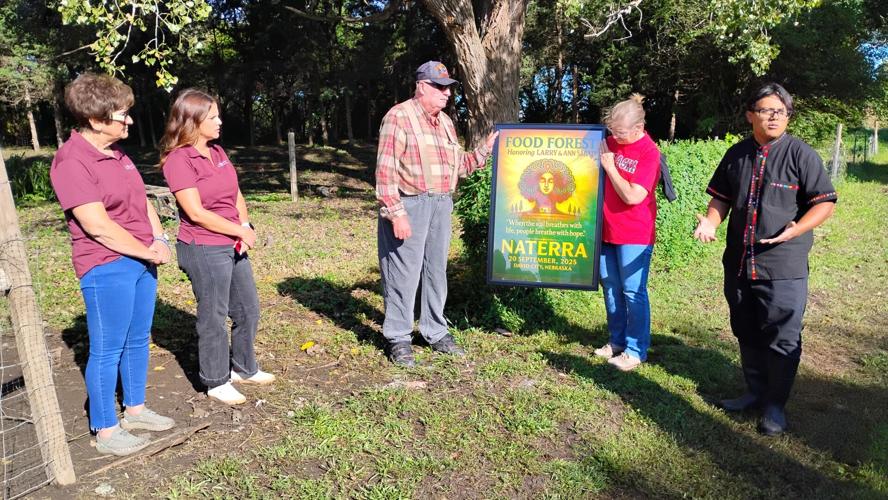
After cutting the ribbon, Lopes revealed a surprise for the Sabatas — a framed poster with the farm’s logo on it. The logo, depicting a large red tree with a female face has ties to Lopes’ history, agriculture and the land. It symbolizes the farming environment that he has cultivated and wants others to try, Lopes said. He hopes this carries on with his children’s education from working on the farm with him.

Sandro Lopes, right, explains the meaning behind the logo for NaTerra Farms in David City, as Larry and Ann Sabata, the owners of the land the farm space is on, hold a poster Lopes made for them, at a ribbon-cutting event on Sept. 20.

“It’s helping us, the animals, the chickens, the goats and everything are grazing here after and before,” Lopes said. “The logo represents that. This is the goddess of agriculture in Tupi, her name is Ceuci. This is the old tree you see back there, because it gives us some spiritual guidance and this is the old house that you see because that means ancestry of the people who live here. It’s very important in the developing a new concept of faming. Then the soil needs to be red because it’s alive.”